
Salt Spray Test for Automotive Coatings: What to Specify Before Testing
Salt Spray Test for Automotive Coatings: What to Specify Before Testing
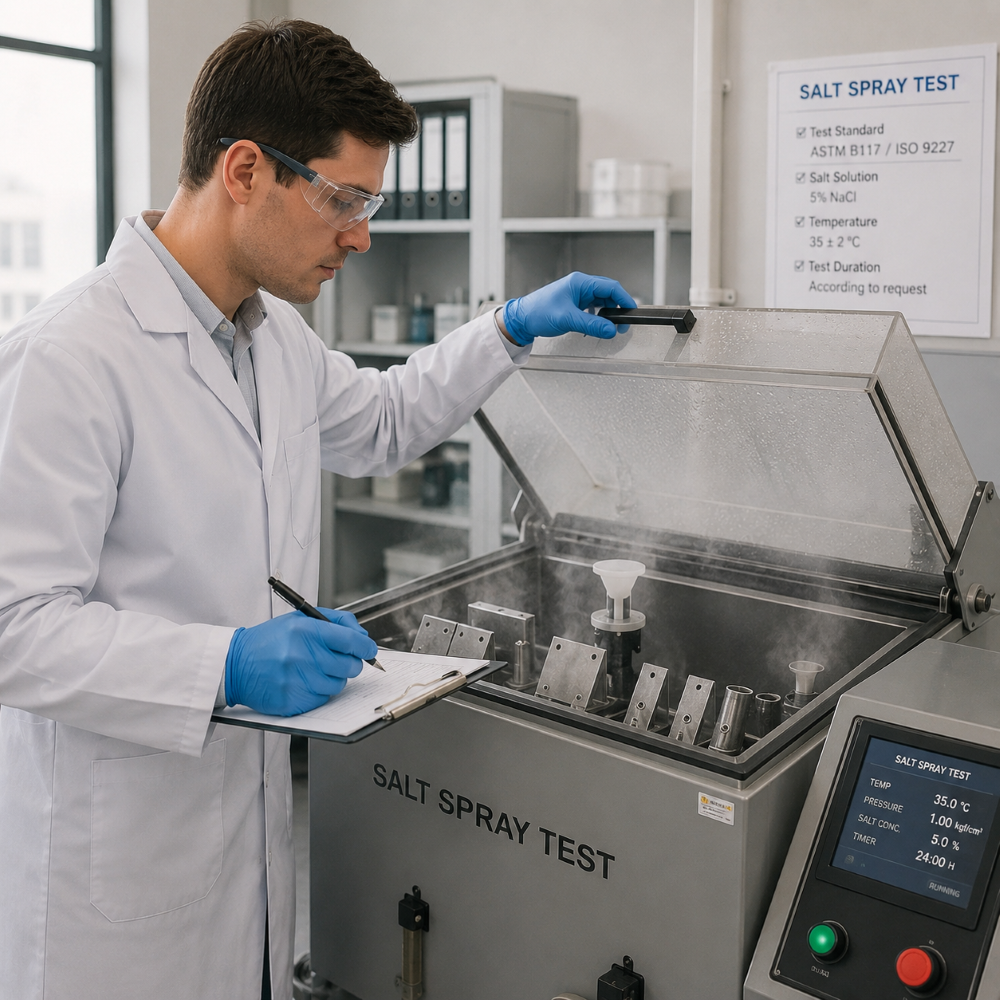
A coated automotive part can look perfectly fine right after production, then start showing white corrosion, red rust, blistering, or coating breakdown once it’s exposed to moisture and road salt. Visual inspection before shipment can’t tell you how a surface-protection system will hold up under a controlled corrosive environment. Salt spray testing exposes samples to an atomized salt solution inside a controlled chamber, and it’s commonly used to compare coatings, qualify suppliers, and confirm whether a part meets the corrosion requirement in an OEM drawing or spec. Test hours shouldn’t get converted directly into years of vehicle life either, since real-world conditions also involve drying, temperature swings, UV exposure, and surface damage that a chamber doesn’t fully replicate.
What a Salt Spray Test Actually Evaluates
The test doesn’t give you one universal corrosion resistance number. The result depends on the material, coating system, test atmosphere, exposure time, and whatever acceptance criteria the customer has set. After exposure, samples usually get inspected for visible changes like white corrosion, red rust, blistering, or corrosion creeping out from a scribed line, and some specs call for interim inspections or photos before the final call.
| What’s checked | What it can indicate |
| White corrosion | Deterioration of zinc or another sacrificial coating |
| Red rust | Corrosion has reached the iron or steel underneath |
| Blistering | Loss of adhesion or moisture trapped beneath a coating |
| Corrosion creep | Spread of corrosion from a deliberate scratch |
| Coating breakdown | Failure of the paint, plating, or protective layer |
A result should only get judged against what’s written in the drawing or customer spec. A part that passes 96 hours hasn’t automatically met a 500-hour requirement.
ISO 9227 vs ASTM B117
ISO 9227 covers several salt spray atmospheres. Neutral Salt Spray (NSS) is the one most commonly used for coated and plated metallic parts, alongside Acetic Acid Salt Spray (AASS) and Copper-Accelerated Acetic Acid Salt Spray (CASS) for more aggressive testing needs.
ASTM B117 describes how to operate salt spray or salt fog equipment and gets referenced a lot by North American customers. It lines up most closely with ISO 9227 NSS specifically, not with ISO 9227 as a whole, since ISO 9227 also covers those AASS and CASS environments that ASTM B117 doesn’t really touch. A lab shouldn’t swap ISO 9227 for ASTM B117, or use continuous salt spray instead of a cyclic method, without the customer signing off first.
Continuous Spray Isn’t the Same as Cyclic Corrosion
Continuous salt spray keeps the sample in a constant fog environment, which is repeatable and controlled but doesn’t reproduce the wet-and-dry cycling a vehicle actually goes through. Cyclic corrosion testing alternates between salt exposure, humidity, drying, and sometimes temperature changes, and gets used whenever an OEM spec calls for that kind of changing cycle rather than continuous fog.
The test method should come from the drawing or customer standard, not from whichever chamber happens to be free. Running a longer continuous test doesn’t necessarily reproduce the same failure pattern a specified cyclic procedure would.
Duration Alone Doesn’t Define Severity
Exposure time can run anywhere from 24 hours to over 1,000 hours depending on the component and spec, with shorter tests used for basic screening and exterior parts or tougher coating systems often needing several hundred hours. Duration has to be read alongside the atmosphere and pass criteria together. A 500-hour NSS requirement isn’t directly comparable to a shorter AASS or CASS test, since the chemical environments aren’t the same. Sample condition matters too, including whether the coating needs to be scribed, masked, mounted at a specific angle, or checked at set intervals.
What to Prepare Before Requesting Testing
A request that just says “do a salt spray test” doesn’t give a lab enough to configure things correctly. It helps to have ready: the applicable standard or OEM spec, the required atmosphere (NSS, AASS, CASS, or cyclic), exposure time or cycle count, coating and substrate details, sample quantity and dimensions, scribe or masking instructions, and the acceptance limits for corrosion, blistering, or creep.
Manufacturers arranging a salt spray test can consult ALS Testing to confirm the standard, atmosphere, exposure duration, and reporting format needed. ALS Testing supports ISO 9227, ASTM B117, and other corrosion-testing requirements for coated and plated automotive parts, with accredited testing available where covered by the applicable scope. Having these details sorted upfront helps avoid delays, wrong chamber setup, and repeat testing.
Treat It as a Defined Qualification, Not a Prediction
Salt spray testing works best when the method and acceptance criteria are clearly set before exposure starts. It lets manufacturers compare coating systems, validate process changes, and show compliance with a customer requirement under controlled conditions.
Manufacturers arranging a salt spray test can consult ALS Testing to confirm the standard, atmosphere, exposure duration, and reporting format needed. ALS Testing supports ISO 9227, ASTM B117, and other corrosion-testing requirements for coated and plated automotive parts, with accredited testing available where covered by the applicable scope.
The laboratory also provides corrosion testing support for manufacturers and suppliers serving the automotive industry in Malaysia, helping verify coating performance against customer and OEM specifications before product release or supplier approval. What it shouldn’t be used for is claiming a part will last a specific number of years on the road. The result only describes how that particular sample performed under the stated method, atmosphere, duration, and inspection criteria, nothing more.
Related Post
เทคโนโลยีการพิมพ์ดิจิทัลล้ำสมัย: อนาคตของการพิมพ์
บทนำ เทคโนโลยีการพิมพ์ดิจิทัลได้พัฒนาอย่างรวดเร็วในช่วง […] [...]

การเปลี่ยนแปลงจากการพิมพ์แบบดั้งเดิมสู่การพิมพ์ดิจิทัล
บทนำ การพิมพ์เป็นหนึ่งในเทคโนโลยีที่มีความสำคัญต่อการพั […] [...]

AI กับการพัฒนาเทคโนโลยีการพิมพ์ 3D และ 4D
บทนำ ในยุคที่เทคโนโลยีก้าวหน้าอย่างรวดเร็ว การผสมผสานระ […] [...]